🎮 1. Overall Market Growth & Scale
- The global online gaming market is expected to keep expanding, with significant revenue growth forecast through the rest of the decade. Market analysts project continued growth toward larger market valuations by 2030, indicating that 2026 will be a growth year within this broader expansion. MarkNtel Advisors
📱 2. Mobile Gaming Remains Dominant
- Mobile gaming will continue to lead the global market by player base and revenue due to smartphone accessibility and rising mobile internet use worldwide. Times Of Games
- Hybrid game models (mixing casual with deeper progression mechanics) are gaining traction, especially in markets like India and Southeast Asia. Campaign India
☁️ 3. Cloud Gaming Accelerates Adoption
- Cloud gaming (playing games via streaming without powerful hardware) is moving toward mainstream adoption in 2026, lowering barriers for entry and expanding global access. Game Industry News
- Wider 5G rollout and edge computing infrastructure may further reduce latency and improve the experience for cloud players. LinkedIn
Challenges: Some services may impose restrictions (e.g., playtime caps) that could shape user sentiment. Windows Central
🧠 4. AI Integration Transforms Gameplay
- AI is increasingly used to power smarter game design, adaptive NPCs, procedural content, and personalized experiences. Built In
- Generative AI tools are also influencing story generation and player engagement, potentially reshaping how games are created and consumed. Tech Research Online
Long-term: AI could become fundamental to dynamic game worlds and player-driven storytelling.
🕶️ 5. VR/AR and Immersive Experiences Expand
- Immersive technologies like virtual reality (VR) and augmented reality (AR) are anticipated to gain more traction, offering social and shared virtual environments rather than just isolated play. cavendishprofessionals.com
- While still a smaller slice than mobile or cloud gaming, these will be key differentiators in next-generation player engagement.
🏆 6. Esports Continues to Mature
- Competitive gaming (esports) is evolving toward strategic, skill-based team formats, with professionalization and larger audiences. The Economic Times
- Growth drivers include deeper analytics, sponsorships, and global livestream platforms.
🌍 7. Geographic Shifts & Local Market Growth
- Rapid growth in regions like India, Turkey, and Pakistan highlights a broader global spread of gaming culture. NorthEast Now
- Local developers are increasingly creating globally relevant games rooted in regional stories and cultures. SpeeQual Games
Regulatory winds: Some countries (e.g., India) are implementing tighter rules against real-money play, which will reshape certain segments of the online gaming scene. Reuters
💸 8. New Revenue & Monetization Models
- Beyond traditional game sales and in-app purchases, monetization is evolving with:
- Season passes and hybrid casual-core models
- Creator and influencer-driven economies
- Esports sponsorship deals and media rights Exploding Topics
🧩 9. Platform Convergence & Cross-Play
- Gamers increasingly demand cross-platform play and shared accounts, blurring lines between PC, mobile, and console gaming. Blockchain Ads
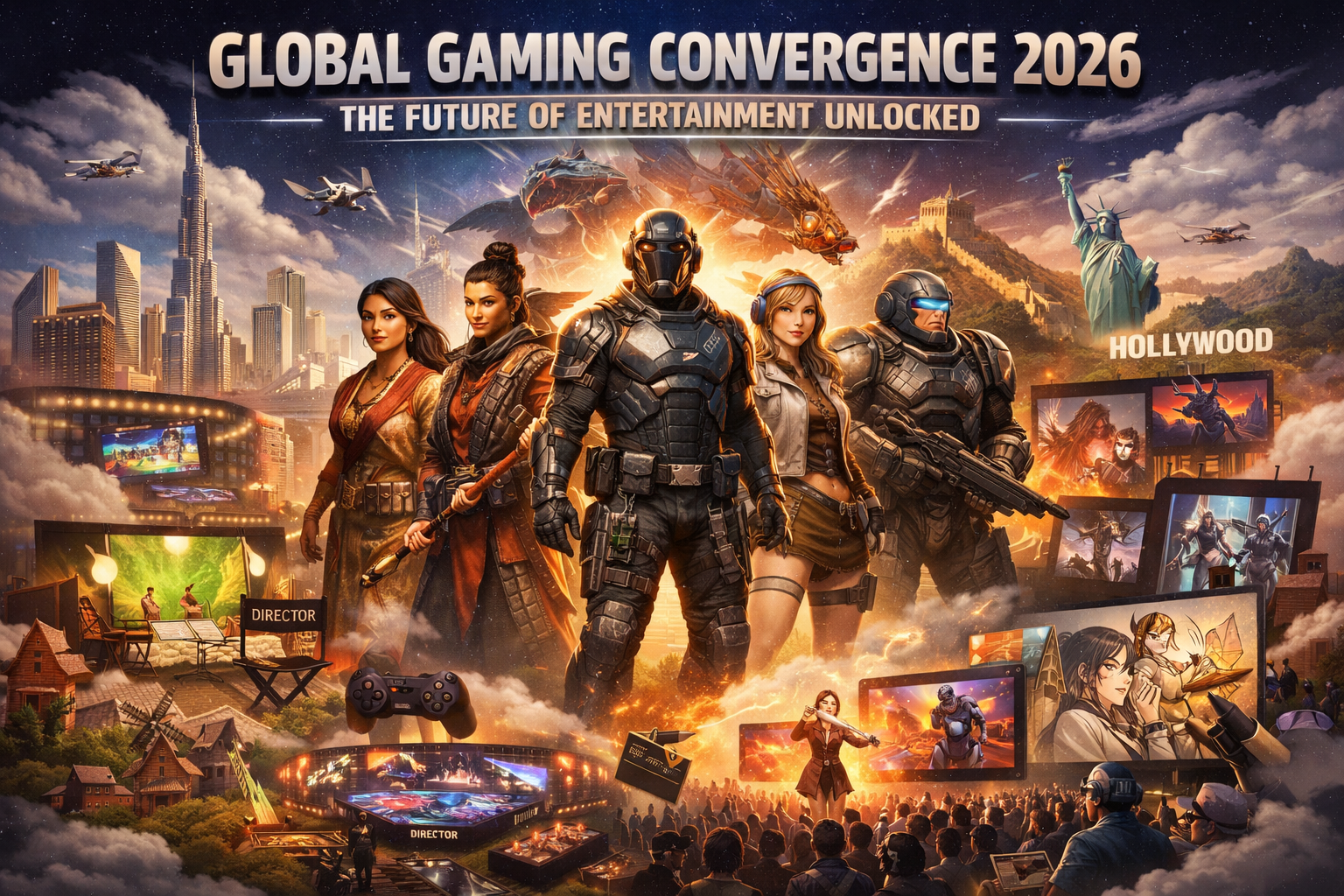
In 2026, online gaming is less “a games business” and more a global IP + community + distribution business—where games sit at the center of a loop that also includes movies/series, comics/manga, creator economies, merch, music, and live events. A few big forces will shape the year:
- Steady-but-strategic growth: the market is big and still expanding, but publishers are prioritizing retention, live-ops, and IP durability over “growth at any cost.” Newzoo
- IP flywheel (games ↔ screen ↔ print): successful worlds and characters are being designed to travel across formats, with adaptations and spin-offs driving new player acquisition back into games. Forbes
- Regulation + safety becomes a product constraint (especially around minors, monetization mechanics, and persuasive design). South China Morning
Below is how India, Dubai (UAE), China, the US, and Europe each play a major role in shaping 2026—globally.
India: massive audience + a regulatory pivot that reshapes business models
India’s role is primarily scale of users + mobile-first innovation, but 2026 is strongly defined by policy and enforcement:
- A major inflection is the Promotion and Regulation of Online Gaming Bill/Act 2025 and downstream enforcement/tax decisions, which are pushing the market away from “money-based games” and re-orienting parts of the ecosystem toward e-sports, social games, and compliant platforms. The Economic Times
- Result in 2026: expect more skill/esports positioning, more compliant casual/social gaming, and heavier emphasis on trust, KYC/age gating, ad restrictions compliance, and “brand-safe” content partnerships.
Media & entertainment link (India)
India is increasingly relevant to global gaming because Bollywood/OTT IP and regional storytelling can become game worlds—and because creators/streamers are now major distribution. The next wave is “IP-native design”: characters built to live simultaneously as series protagonists, comic arcs, and playable heroes (not just one-off tie-ins).
Dubai / UAE: the MENA hub strategy (capital + talent + creator economy)
Dubai’s role in 2026 is platform-building for the region:
- The Dubai Programme for Gaming 2033 positions Dubai as a global hub for gaming and digital content creation—jobs, training, studios, and investment attraction. Dubai Gaming
- Dubai is also formalizing governance/industry coordination (e.g., committees/initiatives) to accelerate ecosystem development. Pocket Gamer
What this means in 2026
- More MENA publishing, esports events, creator studios, and cross-border partnerships (Europe/Asia talent + regional capital).
- Dubai is likely to become a bridge market where studios test Arabic localization, culturally resonant characters, and regional transmedia extensions.
Media & entertainment link (Dubai)
Dubai’s comparative advantage is in becoming a production + creator infrastructure node—where gaming, influencer media, animation/VFX, and brand entertainment converge in one ecosystem.
China: AAA ambition + cultural export, within a tight regulatory frame
China’s 2026 influence comes from production power (especially at scale) and globally resonant IP—while operating under strict content/minor protections:
- China’s licensing/approval environment and regulatory oversight remains central; minors’ protections and rules continue to shape design and operations. Bird & Bird
- China is increasingly proving it can ship globally relevant premium titles: Black Myth: Wukong became a major global moment and signals a broader AAA push. Reuters
What this means in 2026
- Expect more China-origin high-budget titles and more global competition in action/RPG, alongside continued strength in live-service/mobile.
- Content standards and approvals will keep incentivizing myth/history-inspired worlds—which are naturally transmedia-ready (novels, comics/manga-style publishing, animation, film).
Media & entertainment link (China)
China’s strongest connection is mythology-driven IP pipelines (classic tales → modern game worlds → series/film/animation). When a game becomes a cultural event, it also becomes a merch + screen-adaptation engine.
United States: distribution control + “Hollywood-grade” transmedia machine
In 2026, the US remains the center of gravity for:
- Major platforms (console/PC ecosystems, cloud infrastructure, app-store policy gravity),
- The adaptation pipeline (game-to-series and game-to-film becoming mainstream entertainment).
Evidence of the momentum is clear: game adaptations are now consistent tentpoles, with titles like Minecraft (and the broader wave around it) illustrating how game IP drives cinematic/streaming outcomes—and then loops audiences back into games. GamesRadar
Media & entertainment link (US)
The US advantage is the packaging: writers’ rooms, showrunners, merchandising, licensing, talent agencies, and marketing systems built to turn a strong character roster into a multi-format franchise.
Europe: premium craftsmanship + the world’s strictest consumer/protection pressure
Europe shapes 2026 in two big ways:
- Creative/production excellence
Europe continues to produce globally influential studios and premium IP (PC/console craftsmanship, AA/AAA, and strong indie pipelines). - Regulatory influence
Europe is a global pace-setter on consumer protection, loot boxes/in-game monetization, and “fairness by design.”
- The European Parliament and consumer-law framing around loot boxes/virtual items is actively shaping expectations. European Parliament
- Industry bodies are updating standards like PEGI codes on purchasable in-game content, while broader EU scrutiny on addictive/persuasive design is rising. VIDEOGAMES EUROPE
What this means in 2026
- Monetization mechanics increasingly need to be defensible (transparent odds, clearer disclosures, safer defaults for minors, less dark-pattern risk).
- Studios that build “trustable live-service” will be advantaged globally because EU-aligned design often becomes the safest global baseline.
The “media + entertainment” convergence in 2026: how it actually works
Across all regions, the winning pattern looks like this:
1) Character-first development
Studios invest in distinct silhouettes, motivations, backstories, and faction ecosystems so characters can carry:
- a game campaign,
- episodic TV arcs,
- comic/manga expansions,
- and merch/cosplay identity.
2) Transmedia is now a growth channel, not just marketing
Transmedia strategy is increasingly treated as customer acquisition + retention: a series season drops → interest spikes → players return/enter the game world (and vice versa). Game Developer
3) Community + creators are the “new network television”
Creators/streamers shorten the loop between release and culture. IP deals now routinely include creator activations, in-world concerts, watch parties, and social-native story drops.
What to watch closely in 2026 (globally)
- India: how fast the industry rebalances post-2025 legal changes; which platforms win “compliant scale.” Reuters
- Dubai/UAE: how quickly Dubai converts policy + incentives into studio density and regional publishing power. Dubai Gaming
- China: continued AAA breakout moments and how regulations shape design/export strategy. Financial Times
- US: how aggressively Hollywood and streamers keep mining game IP—and whether “game-native storytelling” improves. IndieWire
- Europe: whether EU “fairness” rules harden further, pushing global monetization norms. cadeproject.org
📍 In Summary – What 2026 Looks Like
The online gaming industry in 2026 will likely be defined by:
- Stronger mobile and cloud dominance
- AI-enhanced and more immersive gameplay
- Maturing esports and global competition
- Regional market growth and new consumer segments
- Shifts in monetization and community engagement
- Regulatory and safety considerations shaping policies